
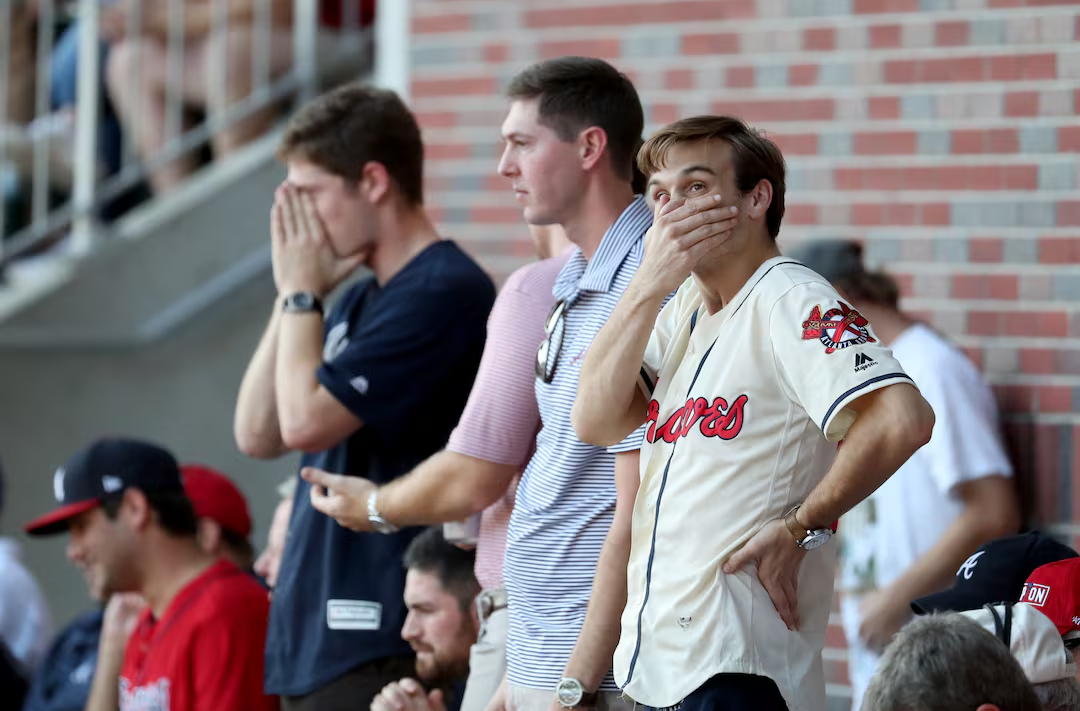
I wrote the following as an email to a friend who is a Phillies fan. Bitterly philosophical at watching the same aging core of expensive veterans fail to win it all as their window continues to close, he began his email by quoting the comments he made the previous year; in those comments, he began by quoting the comments he made the previous year.
The cyclicality of it all is frustrating, a feeling with which I identify, even when (to be honest) watching it happen to the Phillies and Mets is an awful lot of fun. Anyway, he encouraged to vent my own spleen, and what follows is the result of that.
I have not edited it at all, but I will note that the below contains a dig at the team’s lack of progressivenes, a sentiment which certainly comes into contact with the border of the no-politics rule. I’ve made no secret of my willingness to say farewell to the Chop, but I have no desire to otherwise characterize or criticize the politics of anyone on the team or anyone here.
***
I’m not sure I have it in me to write a much longer postmortem, but this, I think, is where I am.
The Braves won the World Series in 2021 by drawing to an inside straight. I am not sure if a Monte Carlo simulation of the season would have brought the championship home to Atlanta five times out of 100. The conclusion, though, seems to have been the same as it was for the previous three decades: the playoffs are a crapshoot, so it isn’t worth trying to improve your odds past the *bare* minimum it takes to punch your ticket to get past the regular season.
Alex Anthopoulos has taken some big swings in the past – he traded for nearly the whole Marlins roster at one point; he brought in Tulowitzki and David Price and made two different brilliant moves to acquire Josh Donaldson. But lately, his hallmark seems to have been the moves he didn’t quite make. The Braves were frequently mentioned at this year’s deadline in the Skubal sweepstakes, and it turned out that they were much closer to a deal for Jacob DeGrom. But they didn’t quite do it. It’s probably not fair to compare AA to Farhan Zaidi, but over the past several years, he has spent a great deal more time trying to claim credit for *not* making moves when it didn’t make sense to make them, than he has spent time announcing moves that he did make.
The 2023 Braves offense was extraordinary. It was easily the team’s best offensive performance since the 2003 team. And it matched their October success by losing in the Division Series. Atlanta has now lost in 12 different Division Series and I’m honestly not sure whether any club has more LDS losses than that. The front office took the loss in stride and appears to have concluded one of two things: either 1) the loss was a fluke, and the team’s true talent would easily catapult them to better results the following season; or 2) the marginal cost of additional wins was too damn high, so doing anything more simply wasn’t worth it.
This wealthy team has made far too many moves based on perceived financial savvy, and all too often they have been penny-wise and pound-foolish. In recent years, the team spent $80 million on contracts for Jurickson Profar, Ha-Seong Kim, and Mike Yastrzemski, for reasons quite similar to the reasons that guided David Stearns in his decision to fill his hole at 1B with Jorge Polanco.
For the past couple of years, I suggested that Anthopoulos was cut off mid-stream, as it seemed as though he had made commitments to spend money that abruptly went unfulfilled, as it seemed that his higher ups may have abruptly cut his budget. At this point, I’m less interested in this particular point. Since the poor playoff showing of that star-studded 2023 team, most of the eight players it sent to the All-Star team have severely regressed, including Sean Murphy, Austin Riley, Ronald Acuña, Spencer Strider, Ozzie Albies, and Orlando Arcia (!). Perhaps it is too much to ask any executive or any team to overcome such extreme setbacks. That’s certainly the message the team would like fans to be willing to accept.
But I tend to think that the team’s emphasis on “posting,” playing every day, is a big part of the problem. Freddie Freeman and Dansby Swanson were the ones who really championed it, and they’re both gone, but it’s hard not to notice that Riley, Acuña, Strider, and Murphy have all suffered major injuries in the past few years, they’ve all tried to come back quickly, and they’ve all seemed to aggravate and reinjure themselves. So: perhaps it’s their fault. Perhaps the team’s simply behind the curve when it comes to player health and sports medicine. And perhaps the team culture is a major detractor.
It is perhaps no accident that in the past couple of years, the team at first stopped playing the Tomahawk Chant over the PA in the wake of severe public criticism, and then it gradually reintroduced it to quell its own fan revolt. The team is not known for its progressiveness, and this is true in multiple areas.
Michael Harris is a superstar. So is Drake Baldwin, though he wore down in October. Chris Sale is a Hall of Famer, and Matt Olson could well be on his way, though tragically it’s hard to say the same for Acuña. There are still some Dudes on this roster, and the farm system had its most promising year in quite some time, with Eric Hartman (who really needs a ’70s-themed TV parody tie-in) rocketing up the prospect lists faster than anyone else in baseball. Alex Anthopoulos pulled off a genuine miracle at the deadline once more when he stole Tyler Mahle for next to nothing.
But next year is such a long way away, and the work stoppage is unlikely to help the team or these players address these issues. The Brewers and the Rays play at such an extraordinarily high level, and watching their games reveals a great deal about what we lack. This team could probably win 85 to 90 games next year and go out in the first round again. But the marginal cost of additional wins is high, and it’s a cost that Alex Anthopoulos has over and over declined to pay.


I think that’s fair, AAR. BUT…
Rather than discuss the Phillies and Mets, let’s talk about the Yankees. You can’t throw a rock in this town without hitting a disgruntled Yankees fan, and they don’t complain about money spent — they complain about bad management. 27 championships! Blah, blah, blah… Steinbrenner! blah, blah,blah. Cashman is a fool! Boone is an idiot!
And yet where are they? They are a very talented team that makes the playoffs most years. They are now falling short because they have mid-90’s-level-Braves pitching combined with a lineup of three guys who you worry about, one of whom was hurt. They spend very freely to get those marginal wins, and they were bounced from the playoffs the same day that the Braves were. Their losing pitcher? Max Fried…. the pretty wealthy Max Fried.
The baseball playoffs are not a crapshoot. That is just cope for losers.
We got lucky to beat a Phillies team who was, like us, a mediocre team who struggled to score runs.
We got shut down by a dodgers team that could pitch and hit. If we had played this series 10 times we may win it once or twice. It took heroic performances from Fuentes and Kerr for us to not get swept. Fuentes of game 4 shows up in game 2 and we do get swept.
Baseball is volatile enough that a mediocre team can beat a strong team in a short series, but that’s still not a crapshoot. It just means luck factors in much more than the NFL, where it is only a minor factor.
The Braves have spent 25 years losing in short order in the playoffs with 2020-2021 being the only departure from that. We lose for reasons and it’s rarely bad luck.
OK, I have a proposition for JonathanF. My theory is that you win the playoffs with good pitching and hitters that can hit good pitching. There was a long period of time that ARod got pilloried for not hitting in the playoffs and HoF’ers can make a career off of hitting mediocre to bad pitching. Do the Braves (or Dodgers or Rays or anyone) have guys other than MoneyMike who can hit good pitching? What are the OPS’ of our guys against elite pitching vs. mediocre pitching. This could be a time consuming analysis so I’ll leave it for the whole winter. But my theory is that it’s no longer a crapshoot when you have hitters that have a history of hitting elite pitching.
The answer to this could explain 2021 as well as many Braves failures.
P.S. We call hitters “streaky”. Are they just blasting bad pitching and failing to hit good pitching?
I love that idea.
I’ll be interested to see what Jonathan comes up with, but I disagree with what I think you’re assuming, that this year’s postseason shows that MoneyMike is an outlier in his ability to hit good postseason pitching. Before this year, in 10 postseason games and 35 PA, he had hit .171/.171/.286. Even including this postseason, his career postseason OBP is below .300. Also, Alex calling him a superstar is interesting considering that a month or so into the season, he had declined every year and looked like more evidence against long-term contracts for young position players (which I generally like, partly because I prefer rooting for the same core group of players for several years to rooting for a core group that changes often).
I suspect that the factors contributing to postseason success are a lot of overall skill, a good bit of random variation/luck, and only a small amount, if any, of true individual ability to outperform in the clutch. Albies hit well this postseason, with 5 XBH in 7 games, but that only brought his career postseason slash line (in 214 postseason PA) up to .250/.318/.375. Since you mentioned 2021, the evidence for that year supports your theory a little more than MoneyMike or Albies do, but it’s mixed. As a group, Rosario, Soler, and Peterson have hit somewhat better in the postseason (including in non-2021 years) than in their regular season careers. Looking individually, though, Soler has been great in the postseason, Pederson has been pretty good, and except for the 2021 postseason, Eddie Rosario has hit .158/.179/.342 in 5 postseason series.
I can think of a couple of ways to check your theory. One would be to look at the last 20 or so years’ worth of WS and LCS MVPs and see if, in other postseasons, they hit better than their combined regular-season totals for those years. A second way would be to look at the top 10 MLB pitchers by ERA for each of the last 10 or so years and look at the batters with the highest OPS’s against them in those years. BRef’s free version lists pitchers’ career totals against each batter, and though that includes pitchers’ weak years, it still might give an idea of which hitters might outperform against good pitchers. The only batters with OPSs over .700 against Greg Maddux, minimum 100 PA (and you probably had to be a good hitter to last long enough to get 100 PA against him) were Tony Gwynn, Luis Gonzalez, Mickey Morandini (?), Barry Bonds, Ray Lankford, Craig Biggio, and Barry Larkin, or 4 HOF-caliber players, 2 good players, and one whose performance against other top pitchers we might want to check. It looks like you can also specify which years you want to consider, but that’s too complicated for me. Third, maybe there’s a correlation between being a good fastball hitter (which I think BRef may show) and doing well in the postseason when more innings will be pitched by guys with great fastballs. Anyway, I’ll be interested to see what Jonathan comes up with.
I have had this same theory for decades, Roger. I believe that Freddie Freeman can hit good pitching, and he is one part of why we succeeded in the playoffs briefly. Been waiting for someone to test the theory. The reason I didn’t want to let Freeman go is that it’s rare to find elite bat-to-ball guys. I believe they also age better than sluggers who strike out a lot. Also not sure if that’s true or just an unfounded hunch.
To be clear: I’m not saying that the answer to all our problems is signing a bunch of guys in free agency. That’s insanely expensive and a lot of those guys turn into pumpkins! There are a lot of ways to improve the team: you can spend money in free agency, you can make prospect trades, you can take on bad contracts to acquire the good players that go with them, you can get lucky with guys who no one expected much of, you can develop prospects into effective contributors.
We’ve done plenty of all of this. The trouble is that the team was willing to stand pat on 16, and you’re not going to win that way.
Glad I’m not the only one who hears “Eric Hartman, Eric Hartman” in his head.
HaHa, yes, same!
I drafted & posted this in reply to Stampton on the last thread while Alex was posting this, so I’ll copy it here: I mostly agree with you on what the team should and will do, but as for its “true” quality, I’ll point out that before the ASB the team was 55-40, .579, +92 runs and after the ASB it was 39-28, .582, though only +24 runs. That looks better than .500 to me. (Basically, I’m saying that if you don’t count the hot start through May, you also shouldn’t give too much weight to the weak June, especially since July & August were both good months.)
I hope we bring back Mahle, but even with his gaudy post-trade ERA, his FIP post-trade was in the 3s. That’s a valuable pitcher, but I hope no other team wants to pay him like his true talent is a sub-2 ERA. He got $10M from SF after going 6-4, 2.18 (3.37 FIP) in 86 IP in 2025, I assume coming off of an injury, and I suspect someone will offer him at least that much after his performance with the Braves despite his poor SF numbers.
I’m not as optimistic as some about our minor league position player prospects, at least not yet. Lodise was 22 this year and hit ok in 400 PA in A ball, hit well in 80 PA in A+, and hit ok (.283/.343/.435) in 100 PA in AA. Gil was 20 and hit well in 160 PA at AA, which is encouraging. Southisene was 19 this year and hit ok in A+; he might turn out to be good, but even if he is, he’s a ways off, and none of the three look to be can’t miss. For comparison, when Albies was 20 he was a highly ranked prospect who put up similar AAA numbers to Lodise’s age-22 AA numbers and spent the last two months in Atlanta, and by the end of his age 22 season he had led the NL in hits and accumulated 10 bWAR. I don’t think the three prospects are in anybody’s top 50 minor league rankings. Hartman struggled in AA, though he doesn’t have much minor league experience yet; he looked very good in A+, but so did Jordan Schafer. I’ll defer to snowshine, but I wouldn’t get too excited about them or make major league personnel decisions with them in mind until they perform well for most of a season in AA or above.
Click to Edit – 26:36
REPLY
Good thoughts. Always tricky to set arbitrary end points. I chose the sweep of the Pirates that ended June 7th because I noticed it as a turning point in our season at the time it happened. We lost 6 of the next 7, and many of our hitters that were due for regression began regressing hard around then.
I’m not saying the minor leaguers are going to pan out, but for a team that is short on money to spend, you have to plan for your positions of prospect strength to help you. We did that with pitching, and so far, it has been a disaster, but it was understandable. I see us doing that with our middle infield rather than spending mega bucks on a shortstop.
I would gladly pay Mahle $10 million for a season, and I think we both know we won’t sign an ace. I think we have to get a short-term bat somewhere.
Fully agree, and unfortunately we’re already locked in to paying Profar and Yaz a combined $25m next year to be that short-term bat. Maybe we can give minor league invites to guys coming back from Japan or Korea, though with a lockout coming I imagine the flow will be going the other way. I know the team has to deal with market realities as far as multi-year contracts, but at least when you get an expensive one-year stopgap who might be good like Cole Hamels or Kim, if it doesn’t work out, you’re not hamstrung in the future.
I think the best (only?) recent example of prospect strength helping our pitching, although it’s not the way you were talking about, was trading Vaughn Grissom, for whom we really didn’t have a position other than maybe LF, for Sale. I thought it was a bad idea at the time, because I have more faith that good hitters will stay good than good pitchers, and because his minor league numbers were really impressive for his age. In four minor league stops at ages 20 & 21, his lowest slash #s were .311/.402/.446 before .291/.353/.440 in 150 PA in Atlanta at 21. At 25, a few months older than Baldwin & Harris, he just hasn’t hit in the majors, though he’s done pretty well at AAA. Certainly didn’t expect that.
AA’s conservative approach to this roster over the last few seasons doesn’t give me much inclination to believe there will be major changes, even more so with the uncertainty of the new CBA looming.
Mahle’s second half earned him a lot of money and he could easily be out of the Braves price range.
Dubon and J.P. Crawford are the top shortstops on the free agent market, and Crawford had a pretty average season. Dubon could also find himself with bigger suitors than the Braves.
The only starting pitchers you can pencil in for 2027 are Sale and Elder.
It’s a tough assignment.
I disagree that the team’s strategy around pitching has been a failure. Seems to me the org has a TON of talent envied by most of the orgs in MLB. We just can’t keep enough of them healthy.
A big part of the “luck” baseball requires and that we all talk about, is just staying healthy. One could argue that every deal AA has made that looks bad right now (Riley, Strider, Murphy) looks bad primarily because those guys got hurt.
The comment made in the post about the team’s approach to player health and recovery may deserve more attention.
Josh I argue that health should be considered when judging success of a strategy. Our 2026 rotation plan was to bet on health of our internally developed pitchers. That plan failed. You can say it was luck, and maybe that’s all it was, but betting on health of young pitchers requires more good luck than betting on health of established pitchers.
What I didn’t say is that our strategy of drafting pitchers as priority hasn’t yielded some good young prospects. It has. And we logically relied on that stable of young arms to fill out our rotation. It didn’t work. We fortunately got heroic performances from Perez, Holmes, and Mahle as well as unusually good health from Sale or we don’t sniff the playoffs. We ended up pitching 3 bullpen games in a row in the playoffs. That is a failure.
“We ended up pitching 3 bullpen games in a row in the playoffs. That is a failure.”
But we won two of those games. Its not entirely clear to me that, if your bullpen is strong enough, pitching bullpen games in the playoffs (where by bullpen game, you leave open the possibility of starters pitching a couple of inning in relief) isn’t a good strategy. Teams with extraordinary starting staffs have no need for such a strategy, but other than the Dodgers and Yankees, who else really could?
Had health been otherwise, those games would have been pitched by either Martin Perez and/or Bryce Elder. Would anyone be more confident about games started by them than by Ray Kerr?
I am not committed to this position, but as important as starting pitching is to get through a regular season, its importance in the playoffs, a land of more rest days and short hooks is clearly attenuated somewhat. Aces can only pitch so many innings, and few teams have more than one ace.
I agree with Jonathan, in this case! Our pitching was quite good all year, including the postseason, injuries notwithstanding. The most pressing issue to fix is our failed offense, not our pitching, which failed to fail!
After some thought, I think resigning Dubon needs to be our #1 priority this offseason. We do not have anyone else major league ready to play shortstop. I don’t consider Jim Jarvis more than a utilityman at the major league level and I don’t think the Braves do either. There is no free agent option that is better than Dubon. If Southisene breaks out next year and proves that he is ready to take over at shortstop, then Dubon can resume the super sub role that was so successful this season.
If we can’t resign Dubon, then AA has to figure out a trade for an everyday shortstop (which he has not been able to do since Dansby left). And if that fails then you’re stuck starting Jarvis at shortstop and praying that he figures it out or that one of the prospects proves to be major league ready. Too many gambles there.
Another question that nobody has brought up: what is Didier Fuentes’ role going forward? Does he move into the rotation? That could fill one of our spots with high upside. Or do we decide to not fix what’s not broken and leave him as a high leverage reliever?
Clearly Spencer Strider cannot handle a starter’s workload. Can he transition to a bullpen role?
Schwellenbach is still cheap, so bringing him back is a no brainer. But if he can’t get healthy in 2027, then he becomes a probable non tender when he becomes arb eligible.
Cmon guys. The plan was not to have 2 reliable starters in the postseason. The fact that Kerr gave a heroic performance doesn’t mean that it was a good idea to count on him to do something you’d never asked him to do and do it in the playoffs for the first time. You can make an atrocious bet and still win. That doesn’t mean it was a wise bet. JonF, you of all people should know that a result doesn’t justify the process.
Now, if we had taken the approach that we don’t develop and pay starters and we spend on offense, and we tried to go bullpen game all the way, that is a reasonable approach. But that’s not what we intended when we signed Strider and relied on Schwellenbach and/or Waldrep and Lopez to be our rotation.
If we go into next season counting on Strider, Schwelly, Waldrep, Reynaldo then get ready for another season on musical pitchers.
And thinking about Profar just makes me angry! lol.
Anyways, Go Brewers! Go Guardians! 2 cities where my friends and I have gone to games so I would be happy to see them raise the flag.